Uncategorized

  • It's time for a revival of critical thinking

    thinking - @boetter - flickr -cc

    The scandal of the evangelical mind is that there is not much of an evangelical mind. ~ Mark Noll

    Evangelicalism and especially the revivalist tradition have often had a very strong anti-intellectual bent. Mainstream Evangelicalism’s continued emphasis on religious experience to the exclusion of critical thought is well intentioned, but ultimately self-destructive.

    We now have generations of people in the church that either simply don’t care or have developed an underlying suspicion of science and logic.

    Unfortunately, this leaves many Christians completely vulnerable to even the most easily refuted attacks against against the reasonableness of our faith.

    “…in your hearts honor Christ the Lord as holy, always being prepared to make a defense to anyone who asks you for a reason for the hope that is in you; yet do it with gentleness and respect, (1 Peter 3:15, ESV)”

    The fact is that the Christian faith is grounded in the historical reality of the resurrection of Jesus, and we have good reasons to believe our confession is true. We have nothing to fear from solid reasoning or science.

    God can handle our questions and the Christian faith is not shaken by a better understanding the world that God has created.

    We need to be teaching the basic principles of valid reasoning and how to apply them not only in theological study, but in everyday conversation.

    Although basic critical thinking skills should be part of everyone’s basic education, this is unfortunately not the case.

    It’s time to make critical thinking a foundational part of our discipleship efforts.

  • 4 ways to keep theological disagreement civil on Facebook

    disagreement - decar66 - flickr - ccHave you ever noticed how theological conversations on Facebook tend to disintegrate quickly? Anger, accusations, and off-the-cuff rhetoric now seem to be standard procedure. I know a lot of Christian leaders that choose to simply not ever engage on Facebook, because it tends to go downhill so quickly.

    I’m convinced it doesn’t have to be this way. You can choose to join or start a conversation in a Christ-honoring way and make a positive impact in the social media space.

    Here are a few things to keep in mind as you venture out into the waters of online theological controversy.

    1) Write with grace

    Remember that you are an ambassador for Christ in this moment. You are not primarily representing your church, your employer, or even yourself. You are representing Jesus himself. Find points of agreement with the person you are conversing with, and make the effort to genuinely understand their ideas.

    Keeping the the tone light and respectful will go a long way toward keep the conversation civil. And speaking of tone, remember that things don’t always come across the way you intend in the written medium. If in doubt, rephrase or explicitly state how you want your idea to come across (for instance: “This is a sincere, not sarcastic question…”)

    Never respond when frustrated, angry, or flustered. Take time to cool off. It can always wait until tomorrow. Avoid deliberately inflammatory rhetoric like the plague. Don’t call people names and don’t throw accusations of heresy around lightly.

    2) Know the limits of the medium

    Facebook threads get pretty unwieldy when the comments get too long. Honestly, it’s just may not the best place to lay out your thoughtful, logical argument for whatever theological truth is under discussion. It seems unlikely to me that a very long response is even very likely to be read. Be concise, articulate, and accurate.

    3) Don’t aim to convince

    Don’t always try to fully persuade the other person of your point of view, especially if you can’t lay out your whole argument in a thorough yet brief way. Instead, provide a compelling thought that could spur further discussion or exploration, and offer to discuss the issue in more detail via private message or email.

    4) Know when to bow out

    If the conversation starts to get repetitive (“As I said in my previous comment,” “Let me restate what I’m actually saying…”) the discussion may be over. If it’s clear you each understand the other’s position, yet neither of you is ready to change their mind, then gracefully bring the thread to a close. If it’s obvious your conversation partner isn’t going treat your arguments seriously or if the other person starts making personal attacks and assumptions, it’s time to stop. Don’t be afraid to write something like this when the time is right:

    “I totally understand your point of view, and I hope I’ve been able to communicate mine accurately. Although we disagree, I’m grateful for what we have common. Grace and peace!”

    * * *

    Don’t waste the opportunity to engage in theological conversation on Facebook. Just choose your battles wisely and remember it takes effort, forethought, and often extraordinary amounts of patience.

  • Why we have to get discipleship right the first time

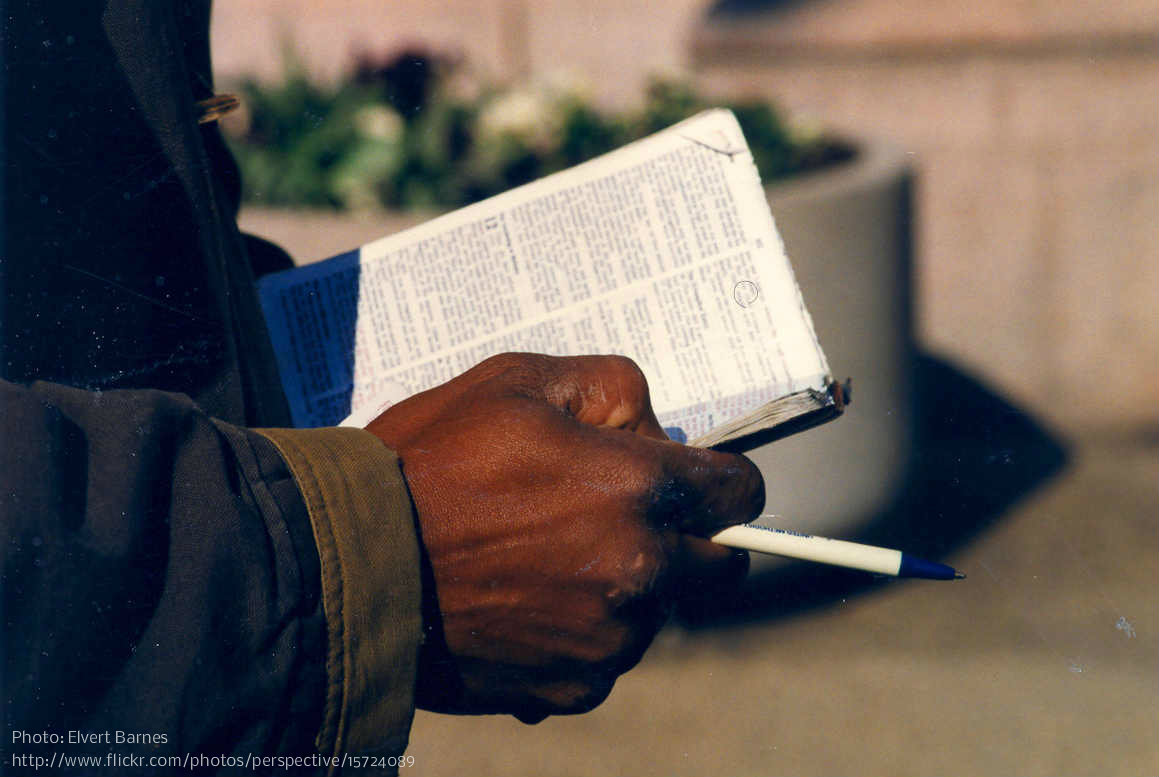
    bible - elvert barnes - flickr - ccIn educational psychology, there are a number of “laws of learning” or “principles of learning.” One of those is called the law of primacy, which basically states that when a student learns something for the the first time, a strong and almost unshakable impression is made.

    “Unlearning” or “reteaching” ideas is therefore incredibly difficult.

    If a student learns incorrect information regarding a topic, the teacher faces an uphill battle when it comes to repairing the mistake.

    This is a huge reason why serious discipleship is so lacking in various parts of the Christian culture. New Christians have basically been taught (often implicitly and usually unintentionally) that learning a few theological basics and having the occasional “quiet time” is enough grow deep in their faith. Read More “Why we have to get discipleship right the first time”

  • 7 Lost Areas of Discipleship

    On a whole, I agree with J.I. Packer that the Church at large just isn’t taking God seriously. At least not as seriously as we should.

    Deep discipleship just isn’t in the program for many local faith communities. I’m beginning to think that if your discipleship programs don’t cause some people to take a step back and say, “Whoa, that’s gonna be pretty tough” then you’re doing something wrong. Discipleship is death to self. It’s serious business.

    The discipleship programs that are prevalent tend to focus on the basic spiritual disciplines of scripture reading and prayer. This is foundational, of course, but not only are there more spiritual disciplines that are essential for spiritual growth, there are entire spheres of our life that are being neglected as areas for discipleship.

    Specifically, I’m thinking of:

    1) Personal Finance

    Stewardship training is often limited to guilt-driven “encouragement” to tithe or “sacrificial giving” to fund buildings. What about teaching people how to live simply, to re-order their values, and to discern where the greatest needs are in their sphere of influence?

    2) Time Management

    How is this not a discipleship issue? In U.S. culture especially, it seems like there should be training on this. Why did God take a Sabbath? Why does he ask us to emulate him in this? What is the spiritual value of rest? Practically, what does it look like to honor God with how we spend our time? These are things that should be addressed with believers young and old.

    3) Physical Health

    Diet and exercise are rarely, if ever mentioned as part of regular discipleship. Gluttony has never been considered in any discipleship group I have been a part of. What we eat matters. How we steward our bodies matter. Every part of our being belongs to Jesus, including our physical selves.

    4) Singleness

    Is it just me or do “singles” programs seem to be more directed at helping Christians find a mate than helping them find their whole identity in Christ as they are? Where is the talk of the great ministry that singles can have? The truth is that singles can devote their lives to ministry in ways impossible for married Christians. Why isn’t this celebrated and understood as a possible calling worth pursuing?

    5) Parenting

    The trend is to offload discipleship to the church. Of course, the whole community has a part to play in raising children, but we bear the primary responsibility for the spiritual health of our own offspring. Is it really enough to make sure they are “involved” in Sunday School or Youth Group and read a Bible story every night? Who is teaching people how to pray for their children, how to help them internalize the Word of God, how to communicate why we believe what we believe?

    6) Social Media

    I think a lot of Christians just don’t know how to communicate about theology and emotionally-charged, big ideas with grace and patience, and especially not in the written medium. This is a problem since so much of our interactions with people we know and people we don’t know are written through social media. We have to start looking at this as a vital area of ministry and recognize that we continue to represent Christ in the digital realm.

    7) Making Disciples

    Every disciple of Christ is called to disciple others. Maybe not formally. Maybe not as part of a program. But every Christian is responsible to be ready to share the reason for their hope, and then to help others follow Jesus with their whole being. Are we equipping the saints for this work, or are we simply using them to attract a few more people to the pews (slash comfy theatre-style seating)?

    * * *
    At the end of the day, it boils down to this: Discipleship is never just about getting the basics of Christian belief and developing a “personal quiet time.”

    Following Jesus is our whole life, and we shouldn’t expect people to just figure it out.

    We’re in this together, so let’s start coming alongside one another, and be intentional about training in these areas.

    We’re not meant to do it alone.

  • My neighbor spent Christmas alone and it was my fault.

    house-flickr-cc

    “Never worry about numbers. Help one person at a time and always start with the person nearest you.” ― Mother Teresa

    We had a wonderful family Christmas. Me, my wife, and my two beautiful kids. Presents, cinnamon rolls, music, the tree, lights, the Christmas story…praying and singing together…walks around the neighborhood with new scooters and toy strollers for new dolls…more cinnamon rolls. It was picturesque, really.

    As part of our Christmas we dropped cookies off with a few of our neighbors…we had been feeling a desire to reach out for a while.

    At 9 p.m. on Christmas night, a single gentleman that lives across the street came by our house to say thanks for the cookies and give us a last minute Christmas card. When I asked him how his Christmas Day had been, he gave a little uncomfortable laugh, shrugged, and said, Read More “My neighbor spent Christmas alone and it was my fault.”

  • Church is a vineyard

    By this my Father is glorified, that you bear much fruit and so prove to be my disciples. (John 15:8, ESV)

    Gregory Nazianzen calls the church a Vineyard, “into which all are summoned as to their place of work, as soon as they are brought to the faith.”1

    Cultivating a quality vineyard takes time, patience, science, study, knowledge, art, dedication, passion for the work. Vineyards require constant care. As vineyards grow, they need many people doing many different things.

    Vineyards become a sustaining source for families, a heritage and a legacy. Whole communities and countries can be known because of their vineyards.

    Is this how we approach being baptized into the Church?

    Is this how we think of being part of our local Christian communities, and part of the Church universal? Is this gathering of believers a living legacy to us, something that we will toil in, so that its fruit might bless the whole world?

    Is it our life’s work?


    1. Edward Harold Browne, An Exposition of the Thirty Nine-Articles, p. 455 
  • Martin Luther actually said this. No joke.

    Recently, a prominent Reformed blogger I read (and generally appreciate) asserted that the the Roman Catholic Church is a false church. Of course, this isn’t the first time I’ve read something like this. It seems to me that this is par for the course among Protestants of all kinds.

    The thing is, apparently even Martin Luther wouldn’t have made such a serious accusation, despite his many harsh words directed toward the Roman Catholic Church and the Pope.

    Luther, for instance, said,

    We call the Church of Rome holy, and the bishops’ sees holy, though they be perverted…there are still Baptism and the Sacrament, the Gospel, the Scripture, the ministry, the name of Christ and God. Therefore the Church of Rome is holy.

    Luther doesn’t stop there. He continues:

    Wherever the Word and Sacraments substantially remain, there is the holy Church.1

    The fact that even the Father of the Reformation realized the Gospel still resided in the Roman Catholic Church deals a mighty blow to the idea of the Gospel as basically equivalent to the doctrine of justification by faith alone.

    Even Calvin acknowledged the validity of Roman Catholic baptism and said,

    …some ruins of a scattered Church exist there…2

    Obviously the Reformers had deep and divisive differences with the Roman Catholic Church. Yet, I am finding in some of their writings a charity that is strangely absent from mainstream Reformation Christianity.


    1. As quoted in An Exposition of the Thirty Nine-Articles by Edward Harold Browne, p. 464 
    2. Ibid. 
  • This Book Will Have the Most Impact on My Ministry This Year

    I believe that mentoring relationships should be at the core of any discipleship program, and they are the foundation of my own ministry. Spiritual direction is something I approach with with a degree of fear and trembling (cf. Matt 18:6), so I’m always on the lookout for resources to help me be better at what I do.

    Mentor Like Jesus was hands-down the most influential book I read for my ministry last year. As I wrote in my review, it’s geared toward older men in a different stage of life than me and the guys I mentor, but the principles are solid and can be applied to anyone looking to disciple a group of others using a model similar to the one Jesus used with his own inner circle.

    When it comes to giving spiritual advice and developing one on one relationships, Spiritual Mentoring by Keith R. Anderson and Randy D. Reese is just as important. Read More “This Book Will Have the Most Impact on My Ministry This Year”

  • How to Start Your New Year Refreshed and Recharged

    With the new year arriving in just weeks, it’s time to rest up and get ready for a new season of life. Don’t let yourself get caught up in the busyness of the holidays! You don’t want to start the new year frazzled and scrambling to catch up.

    A single day of solitude might be just the jump start you need to begin a brand new year with intentionality and energy. Read More “How to Start Your New Year Refreshed and Recharged”